
PRODUCT DESIGN
Vitals+
Physicians spend more time on notes than on patients. Vitals+ gives that time back.
ROLE
Solo Designer
TOOLS
Figma, Protopie
STATUS
Prototype
VALIDATION
Clinically reviewed
The Problem
Physicians are legally required to document every visit in SOAP format. That requirement doesn’t compete with patient care; it competes with itself: the more thorough the note, the less time left in the day to see the next patient. Most EMRs treat this as a scheduling and billing problem. It’s actually a time problem, and the numbers make that hard to ignore.
49%
of a physician’s office day goes to the EHR and desk work, only 27% is spent face-to-face with patients
36 min
spent on the EHR for a typical 30-minute visit, more time on the record than in the room
$500K–$1M
lost per physician who leaves due to burnout, documentation is their #1 cited cause
Why This Matters
This isn’t just an efficiency problem; it’s also a retention problem. Fewer notes standing between a physician and their next patient means more patients seen, and a physician who isn’t finishing charts at midnight is a physician who stays, which is worth far more to the clinic than any efficiency gain on its own.
What's Out There
Jane App
AI Scribe, $15/mo add-on, bolted onto an admin-first platform
Noterro
AI Scribe included free, same admin-first structure
Epic
AI Charting, native ambient scribe launched Feb 2026, built for hospital-scale EHR, not outpatient clinics
Not one of them is built around a physician’s actual daily bottleneck. Billing and scheduling still open first, overdue notes aren’t tracked as something to act on, and even Epic’s new ambient AI is scoped for hospital systems, not the outpatient clinics this problem hits hardest.
The Solution
Vitals+ starts from the homepage a physician actually needs: today’s patients, overdue notes, and new requests, all visible the moment they log in. Drafting a note happens inline, right next to the patient it belongs to, using AI that turns shorthand into a compliant SOAP note in seconds. But speed only matters if the note can be trusted, so nothing saves until the physician reviews and verifies it themselves.
TECHNICAL NOTE
The AI is instructed to elaborate only on what the clinician actually enters, never to infer a diagnosis or treatment plan that wasn’t stated. If a section has nothing to work from, it says so rather than filling the gap. The same “AI assists, clinician decides” principle that shaped the interface shaped the model’s instructions too.
Process
Wireframe to final
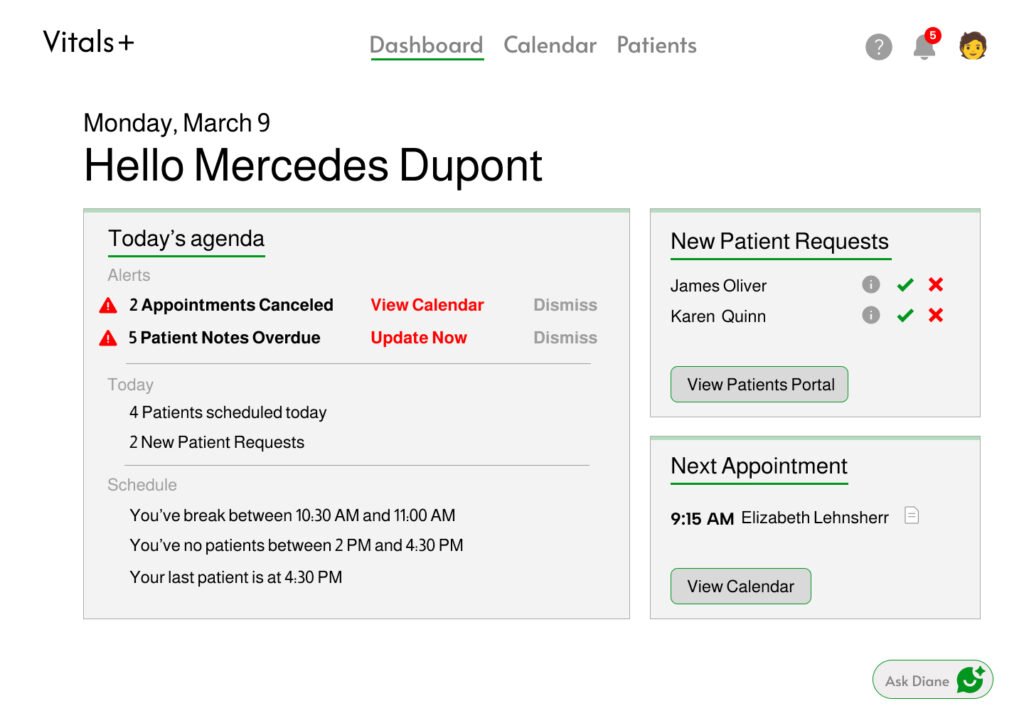
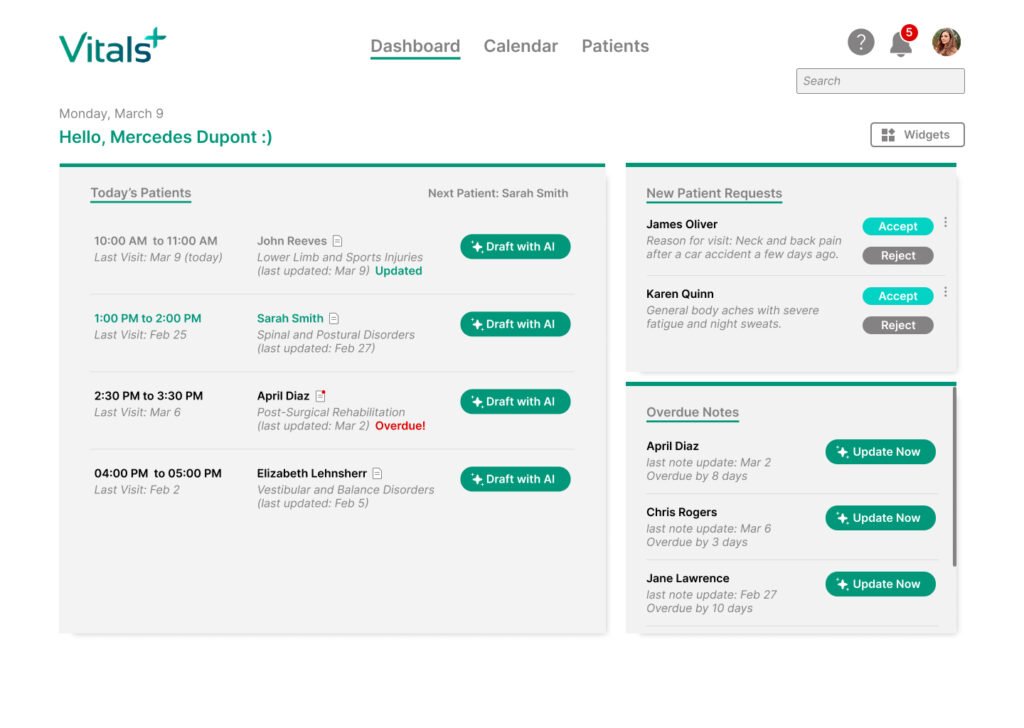
Early wireframes tracked alerts as a plain list, and put AI behind a general chatbot: open it, ask about a patient, get an answer. That's the same passive-trust pattern the verification checkbox later guards against.
Insight: Keeping the clinician in the loop, on purpose
Removing the chatbot and moving AI onto the specific actions it supports kept the clinician doing the clinical thinking, not just approving it. A chatbot still exists for non-clinical support, account and billing questions, where there are no clinical stakes.
SCOPE
In Scope
Dashboard
Calendar
Patients
AI-assisted notes
Deliberately excluded
Chatbot
Tutorials
Tool Tips
Chatting between Clinicians
Familiar patterns (list views, appointment cards, calendars, filterable tables) don't need explaining, so onboarding overhead was cut in favor of interfaces that work on first use.
Key Decisions
Draft with AI
Shorthand in, structured SOAP note out.
Physician-first homepage
Patients, overdue notes, requests, all on login.
Notes history, one click away
AI summarizes prior visits automatically.
Verify before save
Mandatory checkbox gates every save. An early version had none. A physiotherapist testing it flagged the legal risk, which led to this fix.
Live Demo: Draft AI-assisted SOAP Notes
Tested Against the Alternative
A physiotherapist ran the same note three ways: typed from scratch, typed into Gemini as shorthand, and drafted with Vitals+.
6:30
Typing the note from scratch, no AI involved
1:30
Shorthand into Gemini, asked for a SOAP note
1:10
Shorthand into Vitals+’s Draft with AI
The Vitals+ and Gemini prompts weren’t identical, so that specific gap isn’t a fair speed claim. What is fair: AI assistance of any kind cut documentation time roughly 5x over typing it out by hand. And that number doesn’t even count the app-switching, re-reading, and copy-pasting a separate AI tool adds in practice, not measured here, but a real cost the stopwatch misses.
What the comparison actually revealed
Given two lines of shorthand and nothing else, Gemini didn’t just format a note. It prescribed one: specific drugs, a dosage direction, and an imaging timeline, none of which were provided, and none of which a physiotherapist is licensed to prescribe in the first place. Gemini has no way of knowing who’s asking or what they’re allowed to recommend. Vitals+, given a similarly thin prompt, left the Plan section blank rather than invent one. The physiotherapist’s reaction: relief, not frustration, confirmation that the note wouldn’t quietly contain something she didn’t actually decide.
Also in the app
Calendar, color-coded scheduling.
Sortable and filterable patients list. Certain features (billing, invoice) locked to admins.
Reviewed by a board-certified nephrologist and a Mayo Clinic practice chair, who confirmed the note structure holds up against real clinical documentation standards, and called it far cleaner than Epic.
Security & privacy: a known gap, by design
As a prototype, security architecture wasn't designed in depth. But it's treated as a launch blocker, not a feature: any real AI integration would require patient data to be encrypted, never used for model training, and fully HIPAA-compliant before this could go live.
The Outcome
More time with patients
Less time trapped in documentation means more patients seen without extending the day.
Retention protected
Every physician kept off the burnout curve is $500K–$1M in turnover cost avoided.
AI worth trusting
Verification and scoped instructions mean speed never comes at the cost of accuracy.
Reflections
Designing for a licensed clinician means the interface has to earn trust, not just save time. That reframed almost every decision after the verification checkbox: efficiency was never the finish line, accountability was.
What's Next?
NOW
Dashboard, Calendar, Patients, and AI-assisted notes, the core physician workflow, prototyped and clinically reviewed.
NEXT
Role-based homepages for admins, front-desk staff, and physicians; clinician tagging and handoff notes; a native mobile app.
FURTHER OUT
Real HIPAA-compliant security architecture and encrypted, non-training patient data are the actual gate to going live, not a later polish item.